
Argentina’s ‘Blue Dollar’ Remains Stable on May 23rd
Argentina's unofficial "blue dollar" held steady at 1405 pesos for buying and 1425 pesos for selling on Saturday, May 23, 2026. The gap with the official exchange rate remained narrow at 2%.
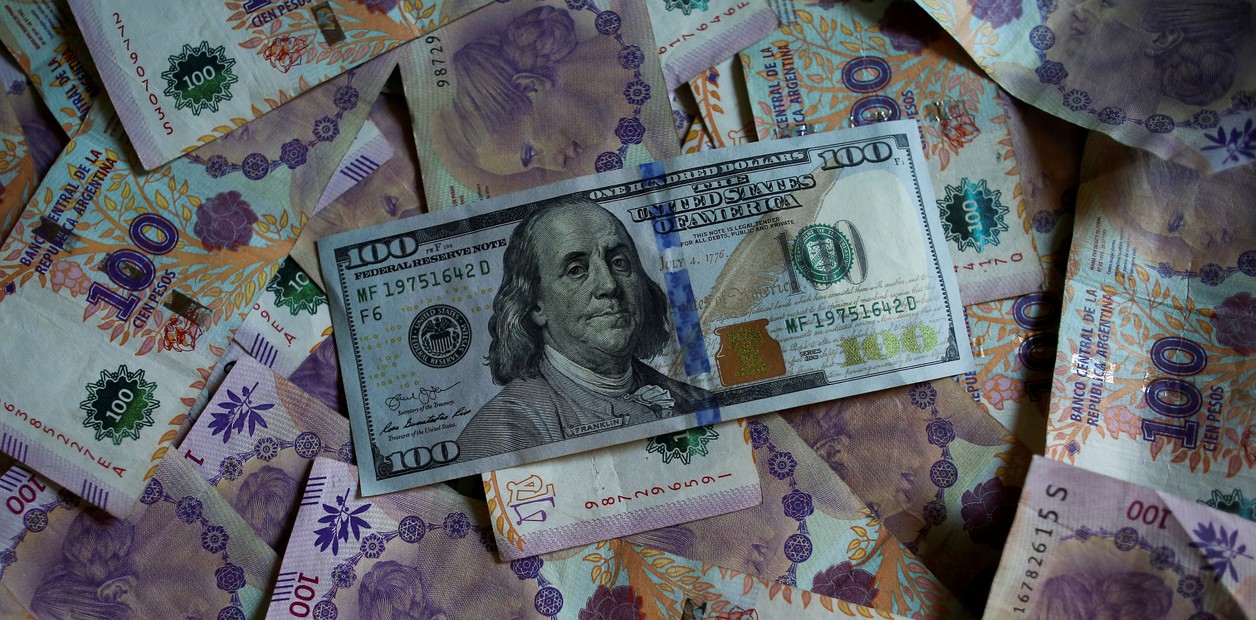
Argentina’s parallel currency market experienced a relatively calm day on Saturday, May 23, 2026, with the unofficial “blue dollar” maintaining its exchange rate. The informal currency was observed at 1405 Argentine pesos for buying and 1425 pesos for selling, showing no significant variation from the previous day’s close.
This stability is notable given the frequent fluctuations that characterize Argentina’s currency exchange market. The consistent rate observed on Saturday provides a clear reference point for those monitoring the various dollar quotations in the country.
Narrowing Gap with the Official Dollar
The difference between the “blue dollar” and the official dollar, which is traded through banks and authorized exchange houses, remains small. Currently, the gap stands at 2%, indicating a convergence in the values of both exchange rates. According to data from Banco Nación, the official dollar was quoted at 1375 pesos for buying and 1425 pesos for selling on the same date.
This narrow difference suggests a market where parallel operations do not show a pronounced divergence from regulated exchange rates. Such a scenario can influence economic expectations and market participants’ decisions.
Monthly and Annual Performance
For the month of May 2026, the “blue dollar” has seen a 0% increase compared to the previous month, indicating a consolidation of its value. However, an annual perspective reveals a 22% increase in 2026 compared to 2025. This annual trend highlights an appreciation of the informal currency over time, despite the recent period of stability.
This annual evolution underscores the inherent volatility of the Argentine currency market and the influence of various economic and political factors that can impact the currency’s valuation.
Understanding the ‘Blue Dollar’ Phenomenon
The term “blue dollar” refers to the US dollar circulating in Argentina’s informal or “black” market. Its name stems from several theories: some associate “blue” with something “dark” or unofficial, while others link it to “blue chip” operations (shares of solid companies) or even the approximate color a counterfeit bill might show when detected with certain markers.
This type of dollar is not traded through official banking channels or authorized exchange houses, and its quotation is typically higher than that of the official dollar. Its exchange rate, like that of the official dollar, closes daily at 3 PM, from Monday to Friday.
Other Market Exchange Rates
In addition to the “blue dollar” and the official dollar, the Argentine currency market presents other important benchmarks. The “dollar bolsa,” also known as MEP (Mercado Electrónico de Pagos) dollar, was quoted at 1424.40 pesos for buying and 1434.30 pesos for selling. Meanwhile, the CCL (Contado con Liquidación) dollar traded at 1485.10 pesos for buying and 1486.60 pesos for selling. These rates reflect different mechanisms for accessing US dollars and are closely monitored by investors and analysts.
The coexistence of these distinct dollar exchange rates is a defining characteristic of the Argentine financial landscape, with each responding to different regulations, supply and demand dynamics, and operational purposes.
Key Exchange Rates on May 23, 2026
- Blue Dollar: 1405 | 1425
- Official Dollar: 1375 | 1425
- Dollar Bolsa (MEP): 40 | 30
- Dollar CCL: 10 | 60
The stability of the “blue dollar,” even if temporary, is a significant economic indicator for Argentina. For FootballGames10 readers, while this news is not directly related to football, understanding the general economic context of countries where leagues and competitions take place is crucial. Economic fluctuations can impact clubs’ ability to make transfers, the value of sponsorships, and ultimately, the competitiveness of tournaments. Staying informed about these macroeconomic variables provides a more comprehensive view of the environment in which the “king sport” operates.
Source: Clarin Deportes – https://www.clarin.com/economia/dolar-blue-hoy-cotiza-sabado-23-mayo_0_94FsEoZkif.html
Source
Clarin Deportes Original publication: 2026-05-23T07:00:03+00:00
Related news
One Injured in Marble Hill Shooting; No Football Disruption Confirmed
A person was hospitalized after a shooting reportedly involving federal agents in New York’s Marble Hill neighborhood. The initial account identifies no…
Read story
Boca vs River Superclásico Confirmed for November 1 at La Bombonera
The Argentine Professional League has set the date and time for the next Boca Juniors vs River Plate Superclásico, scheduled for Sunday,…
Read story
Harry Kane equals Peter Shilton’s England caps record with two goals in Nations League win over Czechia
Harry Kane scored twice on the night he equalled Peter Shilton’s all-time England appearance record, leading the Three Lions to a 3-0…
Read story
Jesse Marsch says Canada “not afraid” as USMNT friendly intensifies rivalry
Canada coach Jesse Marsch has welcomed the pressure of facing the United States, stating his team is “not afraid” as the two…
Read story