
Japan Coach’s Touchline Tactics: A Tactical Board Against the Netherlands
Japan's head coach Hajime Moriyasu employed a unique communication method during their World Cup match against the Netherlands, utilizing a large tactical board to convey instructions to his players.
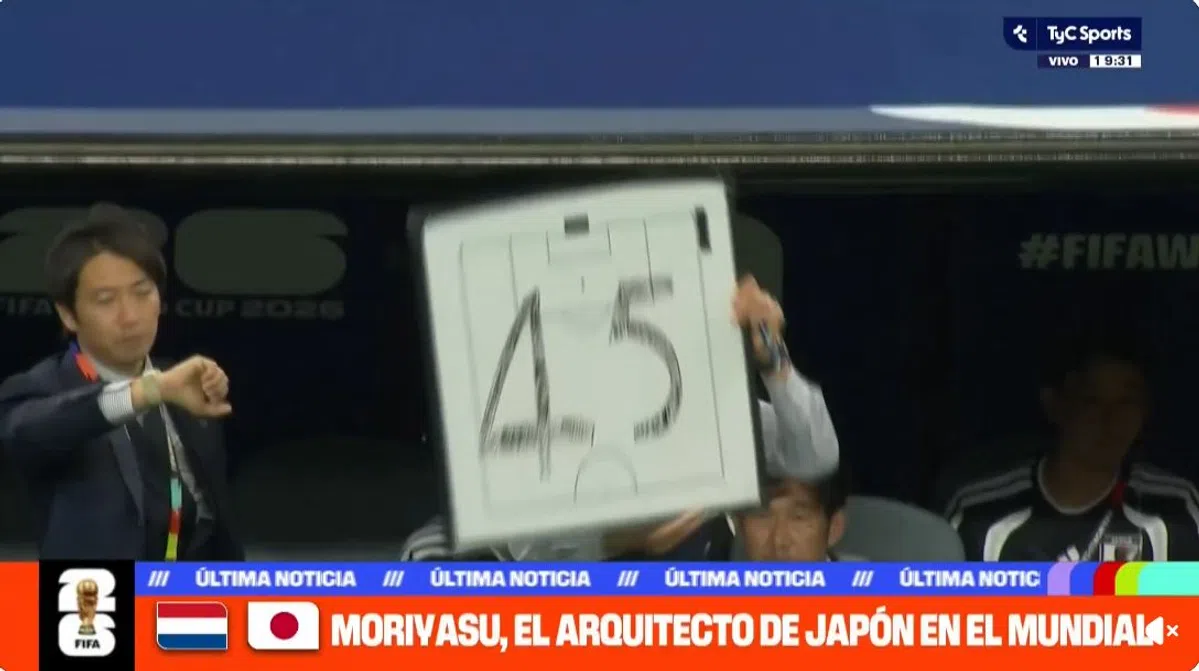
Innovative Touchline Communication
During the opening match of the Netherlands at the World Cup, a draw against Japan, a distinctive scene unfolded along the touchline. Japan’s head coach, Hajime Moriyasu, opted for an unconventional method to communicate with his team: a large tactical board. This innovative approach saw Moriyasu or a member of his staff frequently appearing at the edge of the pitch with the board, displaying numbers to relay instructions.
The challenge of communicating effectively with players on a large field, especially in a loud stadium environment, is a common hurdle for coaches. The Japanese team appears to have devised a practical solution to this issue. During their game against the Dutch national team, the tactical board became a regular feature, allowing for on-the-fly adjustments to strategy. Numbers, some in black (such as 45 or 1) and others in red, were held up, with the aim of capturing the attention of players on the field to implement necessary tactical changes.
Moriyasu’s Post-Match Comments
Following the match, Coach Moriyasu did not elaborate on his specific tactical innovation during the press conference. However, he did express his gratitude for the strong support from the fans. “We received so much support, even though the match was played early in the morning,” he remarked, referring to the time difference between Japan and the United States. “The fans gave our players the strength to come back into the game, twice even.”
He also shared his assessment of the Netherlands’ performance. “I found the Netherlands to be strong as expected,” Moriyasu stated. “We wanted to defend close to our own goal to keep the spaces small. But we were pushed back very far.” This suggests a strategic approach focused on defensive solidity, aiming to limit the attacking options of the Dutch side.
The use of such a visual aid on the touchline highlights the constant evolution of coaching strategies in modern football. While many coaches rely on verbal instructions or hand signals, Moriyasu’s method offers a more direct and potentially clearer way to convey specific tactical information, especially in high-pressure situations. This approach could be a response to the increasing complexity of game management and the need for rapid adaptations during matches.
Key facts
| Detail | Information |
|---|---|
| Match | Netherlands vs. Japan (World Cup opening match) |
| Japan’s Coach | Hajime Moriyasu |
| Communication Method | Large tactical board with numbers |
| Moriyasu’s Post-Match | Pleased with fan support, acknowledged Dutch strength |
| Tactical Aim | Defend close to goal, limit spaces |
Implications for Football Tactics
The adoption of such a visual communication system by a national team coach at a major tournament like the World Cup could influence tactical trends. It raises questions about the effectiveness of different communication methods and how coaches can best support their players’ decision-making on the field. For fans and analysts, it offers a glimpse into the detailed preparation and innovative thinking that goes into elite-level football management. The effectiveness of this specific tactic will likely be further observed in future matches, as teams continue to seek marginal gains in performance.
Source: Voetbal International, https://www.vi.nl/nieuws/opvallend-japanse-bondscoach-zette-groot-tactiekbord-in-tegen-oranje
Source
Voetbal International Original publication: 2026-06-15T05:29:00+00:00
Related news
Celtic’s Europa League struggles deepen as Benfica expose familiar flaws
A 4-1 defeat in Lisbon leaves Celtic with two losses from two Europa League group games. Martin O’Neill sees positives in the…
Read story
Borussia Dortmund Fall to Bodø/Glimt in Champions League Shock
Fredrik Sjøvold’s second-half strike gave the Norwegian side a 1-0 win over Niko Kovač’s Dortmund, who struggled to break down a disciplined…
Read story
Brajan Gruda Strike Gives RB Leipzig 1-0 Champions League Win Over PSV
Brajan Gruda scored in the 75th minute after Maarten Vandevoordt saved an Ivan Perisic penalty as RB Leipzig defeated PSV Eindhoven 1-0.
Read story
Real Betis vs Porto: Champions League Clash Preview and Prediction
Real Betis host Porto in a crucial Champions League league-phase match. Preview includes team news, possible lineups, and analysis of both sides'…
Read story