
Spain’s 16-title run underlines a new era of national-team dominance
Spain’s men’s World Cup win over Argentina has added to a five-year run of senior, Olympic and youth titles across the men’s and women’s game.
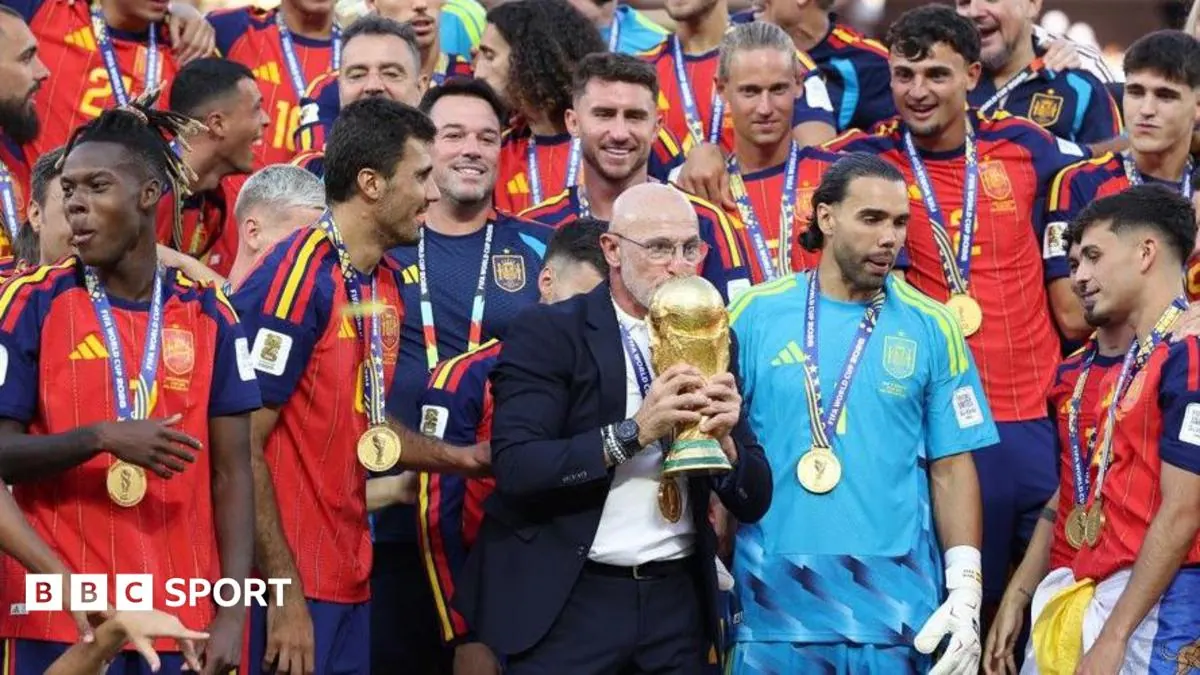
Spain have strengthened their claim as football’s leading national-team system after beating Argentina 1-0 after extra time in the men’s World Cup final in New Jersey, adding another major trophy to a remarkable run across men’s, women’s and youth football.
According to BBC Sport, the result makes Spain the first nation to hold the men’s and women’s World Cup titles at the same time. The women’s team won the 2023 World Cup final against England in Sydney, while the men’s latest triumph follows their European Championship win two years earlier.
The scale of the run is what makes the story bigger than one final. BBC Sport’s analysis counts 16 world and European titles for Spain from under-17 level to senior football across the past five years, with success spread across both genders and multiple age groups.
Key facts
| Item | Detail |
|---|---|
| Latest result | Spain beat Argentina 1-0 after extra time in the men’s World Cup final |
| Major milestone | Spain now hold the men’s and women’s World Cup titles at the same time |
| Five-year trophy count | BBC Sport lists 16 world and European titles from under-17 to senior level |
| Senior men’s run | Nations League 2023, European Championship 2024, World Cup 2026 |
A trophy run across the whole system
Spain’s senior men have now added the 2026 World Cup to the Nations League title won in 2023 and the European Championship won in 2024. That sequence mirrors the country’s previous golden period, when Euro 2008 was followed by the 2010 World Cup and Euro 2012.
The wider numbers are even more striking. BBC Sport lists 11 women’s titles between 2022 and 2026, including the 2023 Women’s World Cup, Nations League titles in 2024 and 2025, an Under-20 World Cup, five straight Under-19 European Championships from 2022 to 2026, and under-17 success at world and European level.
On the men’s side, the five titles in the same period include the 2026 World Cup, Euro 2024, the 2023 Nations League, Olympic gold in 2024 and the 2026 Under-19 European Championship.
For FootballGames10 readers, the key point is not only that Spain are winning finals. It is that their player pipeline appears to be producing tournament-ready footballers at almost every stage, from academy age groups to senior knockout matches.
De la Fuente’s rise from risk to reference point
Luis de la Fuente’s appointment in December 2022 did not arrive with the profile of a superstar club coach. Spain had just gone out of the World Cup in Qatar against Morocco in the last 16, and the federation turned to a coach who knew the national youth structure rather than a high-profile club name.
That choice now looks central to the current era. De la Fuente had previously worked with Spain’s under-19s, under-21s and Olympic team, giving him direct knowledge of many players before they became senior internationals.
BBC Sport quoted Spanish football expert Guillem Balague describing Spain’s success as “the perfect storm”, built on a shared football culture and a refusal to stand still. Former Spain midfielder Juan Mata also told BBC Sport that De la Fuente knew many of the players from the academy pathway and that the squad looks built for both the present and the future.
That continuity matters in international football, where coaches have limited time with players and often have to simplify club-level ideas quickly. Spain’s model appears to have reduced that gap by keeping a consistent style and vocabulary across age groups.
Women’s football has changed the picture
Spain’s dominance is not only a men’s football story. The women’s team’s 2023 World Cup win came in only their third appearance at the tournament, after their debut in 2015, and was followed by Nations League titles in 2024 and 2025.
BBC Sport’s context points to major structural changes in Spanish women’s football over the past decade, including stronger youth categories, improved facilities and better development conditions. Former player and journalist Maria Garrido told BBC Sport in 2024 that the landscape had changed dramatically compared with her playing days, when young players often relied on families for transport and had far fewer professional supports.
That transformation helps explain why Spain’s success is not limited to one generation. Players such as Vicky Lopez and Salma Paralluelo have already collected major club and international experience at a young age, giving Spain more depth for future tournaments.
Youth depth is already visible
Spain’s men’s final win also showed how early the next generation has arrived. BBC Sport noted that Lamine Yamal became the third-youngest player to appear in a men’s World Cup final, behind Pele in 1958 and Giuseppe Bergomi in 1982.
Pau Cubarsi also started the final at 19, meaning Spain became the first team to start two teenagers in a single World Cup final, according to the BBC report. That detail underlines how different Spain’s success is from a short peak built around one ageing core.
The country’s youth titles suggest a broader base. Winning at under-19, under-20 and under-17 level does not guarantee senior trophies, but it does show repeated tournament experience, technical consistency and a supply of players accustomed to pressure games before they reach their mid-20s.
Why this matters for upcoming fixtures
Spain’s next challenge is sustaining the level after a historic peak. De la Fuente was quoted by BBC Sport as saying that, after winning across categories, the next target is simply the next match in September. That message reflects the danger facing any dominant team: once the trophy cabinet is full, standards can slip unless competition inside the squad remains strong.
For readers tracking fixtures, previews and tournament form, Spain’s run changes the baseline for analysis. They are no longer just a talented team with a strong recent tournament. They are a multi-level football system with senior trophies, youth production, women’s success and a clear coaching pathway.
The caveat is that this draft is based on BBC Sport’s analysis and the facts provided in its report, rather than a new official federation release or competition database review. The headline achievement is clear, but the full historical comparison of national-team dominance depends on how titles and age categories are counted.
Source: BBC Sport, “Sixteen titles in five years – why Spain are a dominant force” — https://www.bbc.co.uk/sport/football/articles/c39elvrye40o?at_medium=RSS&at_campaign=rss
Source
BBC Sport Football Original publication: 2026-07-20T01:19:50+00:00
Related news

One Injured in Marble Hill Shooting; No Football Disruption Confirmed
A person was hospitalized after a shooting reportedly involving federal agents in New York’s Marble Hill neighborhood. The initial account identifies no…
Read story
Boca vs River Superclásico Confirmed for November 1 at La Bombonera
The Argentine Professional League has set the date and time for the next Boca Juniors vs River Plate Superclásico, scheduled for Sunday,…
Read story
Harry Kane equals Peter Shilton’s England caps record with two goals in Nations League win over Czechia
Harry Kane scored twice on the night he equalled Peter Shilton’s all-time England appearance record, leading the Three Lions to a 3-0…
Read story
Jesse Marsch says Canada “not afraid” as USMNT friendly intensifies rivalry
Canada coach Jesse Marsch has welcomed the pressure of facing the United States, stating his team is “not afraid” as the two…
Read story