
US Military Helicopter Drill in Caracas Signals Strategic Shift, Analysts Say
A U.S. military evacuation simulation in Venezuela's capital, featuring advanced Osprey aircraft and naval support, is analyzed as a strategic signal to global powers and a demonstration of operational capability within the region.
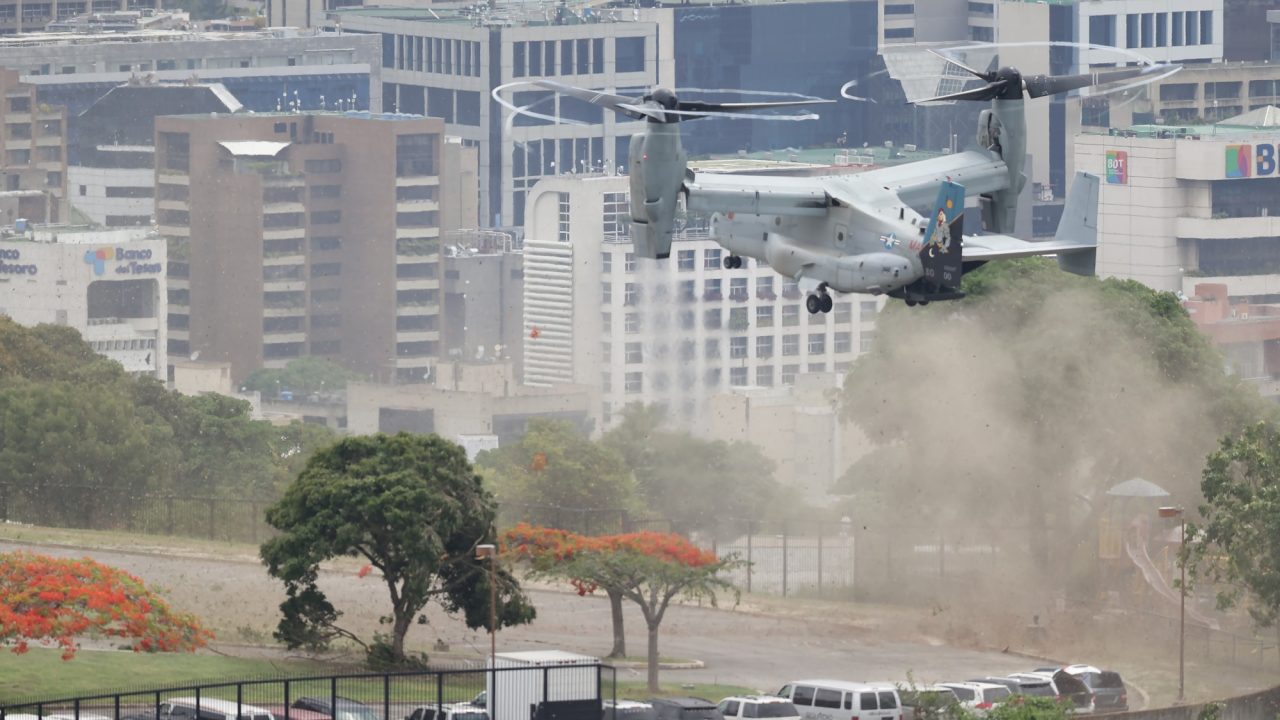
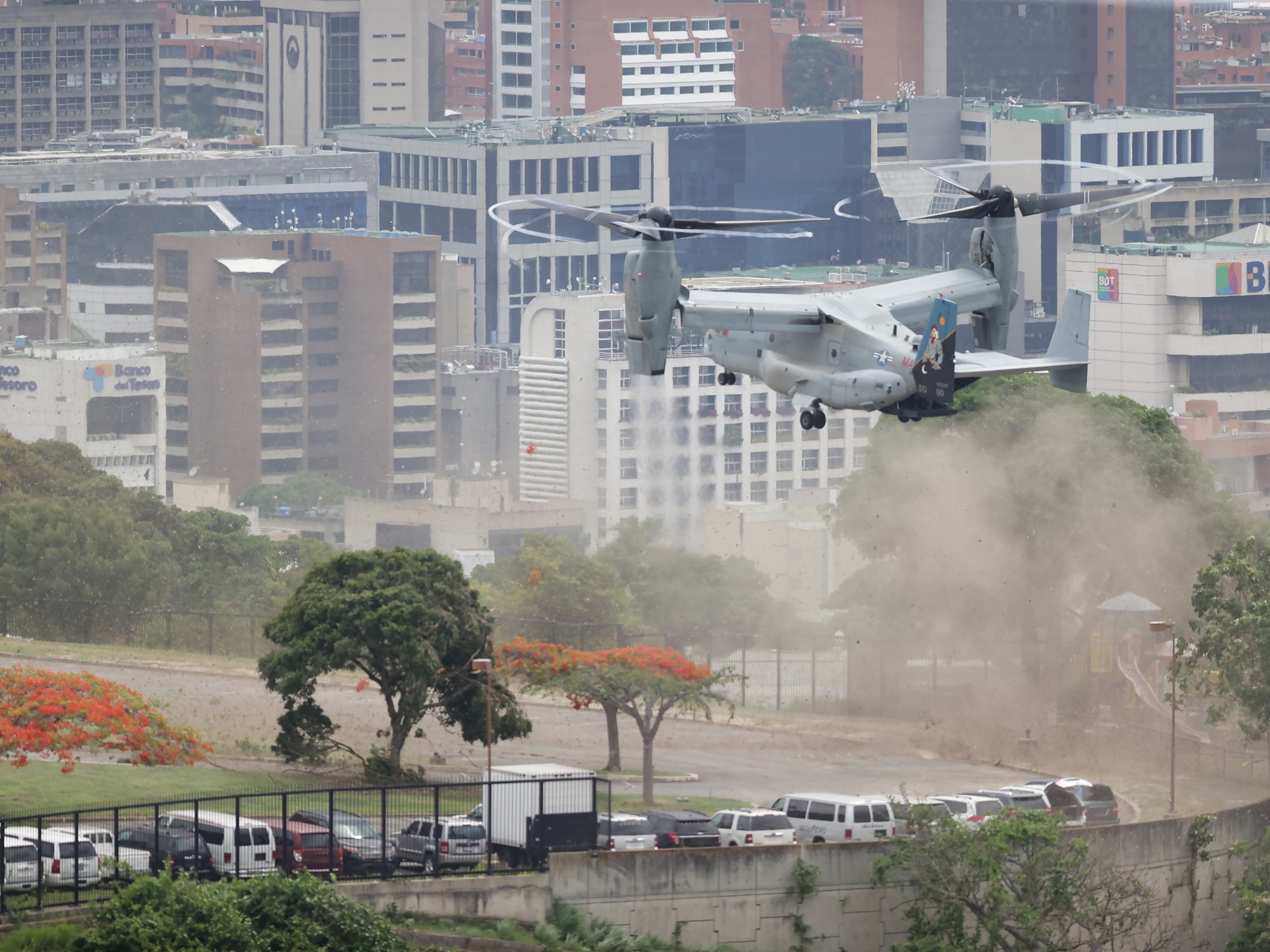
A recent U.S. military exercise in Caracas, involving the simulated evacuation of the U.S. Embassy, has been interpreted by observers as a significant strategic demonstration with implications for global geopolitical dynamics, particularly concerning China and Russia. The drill, which saw two large MV-22B Osprey tiltrotor aircraft fly over the Venezuelan capital under the direction of U.S. Southern Command (SouthCom) chief General Francis L. Donovan, was officially described as an evacuation drill. However, for some analysts and local observers, the operation resembled more a deployment of elite, heavily armed forces, signaling a readiness for future operations and a projection of U.S. military capability within Venezuela.
Strategic Display of Force
The presence of the Ospreys, known for their speed and versatility, along with supporting naval assets including the guided-missile cruiser USS Lake Erie and the amphibious assault ship USS Iwo Jima, anchored offshore, underscored the scale of the U.S. military’s logistical and operational reach. This display occurred amidst a backdrop of Venezuela’s complex political and economic situation, and its relationships with international powers.
The exercise, authorized by the Venezuelan government under Delcy Rodríguez, was framed by the U.S. Embassy as a commitment to the “three-phase plan of President Donald Trump,” focusing on Venezuela’s stabilization and shared security within the Western Hemisphere. The embassy stated its dedication to a “free, secure, and prosperous Venezuela.” This marks the second such elite U.S. Navy commando unit visit to Caracas, suggesting a sustained U.S. interest in the region.
A Venezuelan military source, speaking anonymously to Clarin, suggested that the U.S. is employing a “multi-domain pressure” strategy, which includes controlling strategic nodes, cognitive dominance, calibrated force demonstrations, psychological degradation of adversaries, and preserving governance while managing diplomatic, military, and narrative fronts. This perspective posits that the air exercise, the presence of SouthCom, and the naval deployment are not merely tactical maneuvers but multi-level strategic messages.
Symbolism and Psychological Impact
The source emphasized the symbolic weight of the MV-22B Ospreys landing in Caracas. The implied message, according to this interpretation, is not about imminent military defeat of an adversary but about establishing a perception of U.S. capability, reach, and freedom of operation. The ability to “enter, exit, evacuate, insert forces, and operate in the political heart of the country” is seen as a key takeaway. This messaging is directed at military commanders, intelligence structures, economic operators, and support networks, conveying Washington’s presence, access, logistical superiority, and capacity for rapid escalation if necessary.
This strategic projection is viewed as a precursor to the potential future establishment of U.S. military bases, contingent on the approval of interim Venezuelan authorities. The military source described this as a necessary and complementary phase, involving gradual projection to safeguard oil facilities, moving from psychological pressure to narrative control.
Geopolitical Implications for Russia and China
The exercise is also seen as a strategic maneuver to displace the influence of Russia, China, and Iran, which have been significant suppliers of arms to Venezuela. By demonstrating a strong U.S. military presence and operational capability, Washington aims to signal its strategic dominance in the region and potentially alter the existing geopolitical alignments. The source suggested that Venezuela is becoming the “Theater of Operations” for U.S. Southern Command, a development that could reshape regional security dynamics and international relations.
The narrative from the Venezuelan source also touches upon the issue of sovereignty. It is argued that Venezuela’s sovereignty has been compromised under the current regime, with the presence of irregular armed groups like the ELN and FARC dissidents, and criminal organizations such as Tren de Aragua, rendering claims of national sovereignty questionable. In this context, the U.S. military presence, with the stated goal of dismantling these “nodes” with interim authority approval, is framed as a necessary step towards restoring stability and order.
Public Reaction and Official Statements
The U.S. Embassy’s statement aimed to reassure the Venezuelan population, emphasizing continued commitment to the stabilization plan and shared security. However, the drills themselves have drawn attention and, according to reports, protests from government supporters who view such exercises as an infringement on national sovereignty. Despite these criticisms, the underlying assertion from the military source is that Venezuela’s sovereignty is already diminished, making the U.S. military’s operational involvement a complex issue with deep roots in the country’s ongoing political and security challenges.
Key Facts of the Drill
- Event: U.S. military simulated evacuation drill in Caracas.
- Participants: MV-22B Osprey helicopters, USS Lake Erie, USS Iwo Jima, SouthCom Commander General Francis L. Donovan.
- Official Objective: Simulated evacuation of the U.S. Embassy.
- Strategic Interpretation: Demonstration of force, projection of capability, and a message to China and Russia.
- Context: Venezuela’s geopolitical relations, regional security, and alleged presence of armed groups.
- Source: Clarin Deportes report based on unnamed Venezuelan military source and U.S. Embassy statements.
What remains unclear
While the U.S. Embassy framed the exercise as a routine drill and a commitment to Venezuela’s stabilization, the specific nature of the “three-phase plan” and the exact conditions under which U.S. military bases might be established remain unspecified. The extent of authorization from Venezuelan authorities for such military activities, beyond the stated approval for the drill, is also not fully detailed. Furthermore, the precise impact of this demonstration on China and Russia’s strategic positioning in Venezuela and the wider region requires further observation and analysis.
The development holds significance for FootballGames10 readers by highlighting the intersection of international politics and military strategy in a region with substantial sporting ties. Understanding these geopolitical undercurrents can provide context for the stability and future of sporting events and infrastructure in South America, as well as the potential impact on international sporting relations and player movements.
Source: Clarin Deportes, https://www.clarin.com/mundo/venezuela-convierte-teatro-operaciones-comando-sur-estados-unidos-senal-china-rusia_0_cNP0b30CFj.html
Source
Clarin Deportes Original publication: 2026-05-25T22:40:55+00:00
Related news
Celtic’s Champions League Collapse: A Timeline of the LASK Disaster
Celtic threw away a 4-0 aggregate lead against LASK in the Champions League qualifiers, suffering a humiliating 5-4 defeat after extra time.…
Read story
Body of Missing 5-Year-Old Belgian Boy Likely Found Near Football Club; Father Still Missing
The body of 5-year-old Tyméo Brigou, missing since late June, has likely been found in a wooded area just two kilometers from…
Read story
Serie A clubs Lazio and Fiorentina show interest in free agent Mauro Icardi
The 33-year-old Argentine striker remains a free agent after leaving Galatasaray, with Lazio and Fiorentina both considering a move before the Italian…
Read story
Therian Interrupts “Aura Farming” Gathering in La Plata, Gets Escorted Out by Crowd
A person identifying as a therian briefly disrupted a large "aura farming" meetup in La Plata's Plaza Moreno on Saturday, only to…
Read story